Câu 165
Nội dung nào sau đây phản ánh không đúng cuộc đấu tranh bảo vệ, thực thi chủ quyền, các lợi ích hợp pháp của Nhà nước Cộng hòa xã hội chủ nghĩa Việt Nam ở Biển Đông?
Đáp án và lời giải
Đáp án: A
Nội dung nào sau đây phản ánh không đúng cuộc đấu tranh bảo vệ, thực thi chủ quyền, các lợi ích hợp pháp của Nhà nước Cộng hòa xã hội chủ nghĩa Việt Nam ở Biển Đông?
Đáp án: A
Dựa vào thông tin sau đây và trả lời các câu hỏi:
Cách mạng tháng Mười đã đánh đổ chủ nghĩa tư bản ở một khâu quan trọng của nó là đế quốc Nga, chiếm 1/6 diện tích trái đất. Cũng từ đó, một xã hội mới ra đời - xã hội xã hội chủ nghĩa mà mỗi bước phát triển của nó đều gây nên một sự tương phản đối lập với hệ thống tư bản chủ nghĩa. Mặt khác, cuộc Chiến tranh thế giới thứ nhất không chỉ để lại những tổn thất nặng nề về của cải, sinh mạng, làm cho tất cả các nước thắng trận và bại trận đều bị suy yếu (trừ Mĩ) nhưng nghiêm trọng hơn, dẫn đến sự phân chia lại thế giới theo "hệ thống Vecxai - Oasinhtơn", làm nảy sinh những mâu thuẫn mới hết sức sâu sắc giữa các đế quốc, từ đó dẫn tới Chiến tranh thế giới thứ hai (từ 1918 đến 1945). Chủ nghĩa tư bản không có những thời kì ổn định về chính trị, phát triển về kinh tế kéo dài như trước đây nữa mà chỉ có một thời gian ngắn ngủi trong những năm 1924 - 1929, rồi sau đó lâm vào cuộc khủng hoảng kinh tế thế giới 1929 - 1933, dẫn tới sự lên cầm quyền của chủ nghĩa phát xít ở nhiều nước: Italia, Đức, Nhật Bản, Tây Ban Nha, Bồ Đào Nha, Bungari, Hunggari... Kết quả, chủ nghĩa đế quốc đã phân thành hai khối đế quốc đối lập, "hệ thống Vecxai - Oasinhtơn" bị phá vỡ. Chiến tranh thế giới thứ hai bùng nổ, kết thúc một thời kì phát triển của lịch sử thế giới hiện đại.
(Lịch sử thế giới hiện đại (1917 – 1995), NXB Giáo dục, tr.220)
Cách mạng tháng Mười Nga thành công đã đánh dấu
Đáp án: A
Cách mạng tháng Mười Nga thành công tạo ra sự thay đổi gì trong hệ thống trật tự thế giới thời kì hiện đại?
Đáp án: B
Dựa theo đoạn trích, đặc điểm chung của chủ nghĩa tư bản trong giai đoạn 1919 – 1939 là gì?
Đáp án: B
Theo Âm Dương lịch, ngày nào sau đây được gọi là ngày xuân phân?
Đáp án: B
Sản phẩm của ngành công nghiệp nào sau đây không lưu giữ được?
Đáp án: B
Các quốc gia của EU thuộc nhóm G7 là
Đáp án: D
Phát biểu nào sau đây là đúng về sự phát triển mạnh mẽ của ngành dịch vụ Hoa Kỳ?
Đáp án: A
Nhận định nào sau đây đúng về đặc điểm dân cư Đông Nam Á?
Đáp án: C
Cho bảng số liệu:
Tỉ suất sinh thô và tỉ suất chết thô của một số quốc gia năm 2022
(Đơn vị: ‰)

Dựa vào bảng số liệu trên, hãy cho biết nhận xét nào sau đây không đúng?
Đáp án: B
Vấn đề đặt ra trong thăm dò, khai thác, vận chuyển và chế biến dầu khí ở nước ta là
Đáp án: B
Cho bảng số liệu:
Diện tích rừng của nước ta giai đoạn 1943 – 2024
(Đơn vị: triệu ha)
|
Năm |
1943 |
2015 |
2024 |
|
Tổng diện tích rừng |
14,3 |
14,1 |
14,9 |
|
Diện tích rừng tự nhiên |
14,3 |
10,2 |
10,1 |
|
Diện tích rừng trồng |
0 |
3,9 |
4,8 |
Nhận xét nào sau đây đúng với bảng số liệu trên?
Đáp án: B
Sự hình thành gió phơn tây nam ở đồng bằng ven biển miền Trung nước ta là do tác động kết hợp của
Đáp án: D
Đáp án: A
Nước ta cần phải khai thác tổng hợp kinh tế biển và hải đảo không phải do
Đáp án: D
Việc trồng rừng ven biển ở Bắc Trung Bộ có vai trò chủ yếu nào sau đây?
Đáp án: C
Thế mạnh chủ yếu để phát triển ngành dịch vụ ở Đồng bằng sông Hồng là
Đáp án: C
Biện pháp chủ yếu ứng phó với hạn mặn trong nông nghiệp ở Đồng bằng sông Cưu Long là
Đáp án: C
Dựa vào bản đồ dưới đây (Atlat Địa lí Việt Nam, Nxb Giáo dục Việt Nam, 2025) và kiến thức đã học, trả lời 3 câu hỏi dưới đây.
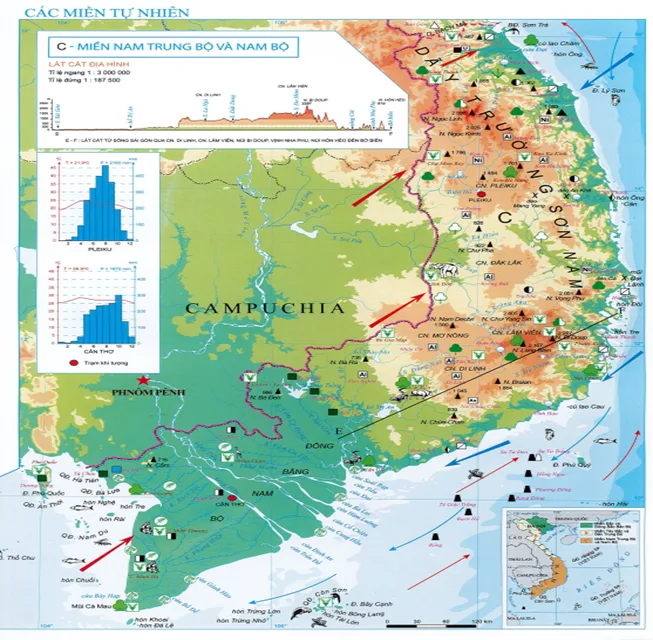
Trong các mũi đất sau, mũi nào nằm xa nhất về phía nam?
Đáp án: C
Phát biểu nào sau đây không đúng với thiên nhiên vùng đồng bằng Nam Bộ?
Đáp án: B
Miền Nam Trung Bộ và Nam Bộ có biên độ nhiệt độ năm nhỏ chủ yếu do tác động của
Đáp án: B
The scientist _______ theory revolutionized physics was awarded the Nobel Prize.
Đáp án: D
After months of deliberation, the committee finally admitted _______ mistakes in calculating the environmental impact of the construction project.
Đáp án: A
In order to preserve constitutional rights, journalists _______ verify sources carefully before publishing sensitive information.
Đáp án: D
Which of the following countries is frequently ranked among the most _______ destinations for higher education, attracting students from around the globe?
Đáp án: B
The research team is currently _______ revising their methodology after receiving critical feedback from the peer-review committee.
Đáp án: A
His lecture was truly _______ to all the graduate students in attendance.
Đáp án: C
If Sarah _______ more decisive, she could have become the team leader.
Đáp án: B
Stairways can be secured with ______ high gates, remembering that adults can climb over gates which are designed for children.
Đáp án: B
The university aims to get undergraduates _______ advanced research projects by the end of their second year.
Đáp án: C
Policy-makers had better _______ the long-term effects of automation before implementing large-scale industrial reforms.
Đáp án: C
A Baby sea turtles are the most vulnerable when they leave their nests and make their way to the sea.
Đáp án: C
The Wilsons have found it terribly hard to make ends meet ever since they both lost their jobs.
Đáp án: A
It is predicted that the natural resources will run out by the end of the century.
Đáp án: D
He is the epitome of a poacher turned gamekeeper. Once commander of the whaling station, he now devotes his energy to saving the whale and other marine life of the area.
Đáp án: A
Mark: I heard you’ve been working late almost every day this week.
Lena: Yeah, the deadline’s coming up, so ____________.
Đáp án: A
Anna: Thanks for helping me carry these boxes.
Tom: ___________
Đáp án: A
Susan shared with her friend about her losing purse.
Susan: "I have lost my purse."
Her friend: “_______”
Đáp án: B
Sophia: Do you think we should go ahead with the plan despite the risks?
Daniel: I’m not entirely convinced, but ____________.
Đáp án: B
a. Honestly, I don’t think this plan will work unless we get more funding.
b. But what if we cut down on marketing expenses for the first quarter?
c. That could be an option, though it might affect our visibility.
d. So what alternative do you suggest?
Đáp án: C
a. Sorry for interrupting, but could you clarify what you mean by “hybrid model”?
b. It refers to a combination of remote and in-office work.
c. Thanks, I just wanted to be sure I understood correctly.
d. No problem at all, glad to explain.
Đáp án: A
a. I can’t believe the deadline was moved forward again.
b. Really? That gives us hardly any time to prepare the presentation.
c. So what’s our plan? Are we going to divide the tasks differently?
d. I know, and the client has added extra requirements on top of that.
e. That sounds fair. Let’s get started right away.
f. Yes, I’ll handle the research part, and you can focus on the slides.
Đáp án: D
a. Here a great deal of grain is grown.
b. In recent years, however, progress has been made also in the field of industrialisation.
c. Most of this country consists of an extremely fertile plain, through which the river Danube flows.
d. Hungary, with a population of about 10 million, lies between Czechoslovakia to the north and Yugoslavia to the south.
e. In addition to grain, the plain produces potatoes, sugar, wine and livestock.
f. The new industries derive mainly from agricultural production.
Đáp án: C
Fortunately, the car was travelling too slowly for anyone to be badly hurt in the accident.
Đáp án: B
Hardly any of the islanders have failed to adapt to modern life.
Đáp án: D
Donating some of your wages to a charity will not only help unfortunate people, but it will also give you a sense of pleasure, whichever charity you support.
Đáp án: B
If the government had dealt with the crisis properly, inflation wouldn’t continue at high levels now.
Đáp án: A
The coffee was very strong. He couldn't drink it.
Đáp án: A
Sarah didn't wear a raincoat. She got soaked in the rain.
Đáp án: B
The new smartphone is expensive. It is, however, very popular among teenagers.
Đáp án: A
He finished the project. He then went on a long vacation.
Đáp án: B
Đáp án: B
Đáp án: A
Đáp án: D
Đáp án: C
A recent study highlights the urgency, warning that (135) could close the window for recovery.
Đáp án: A
Read about the Earth's tectonic plates, then answer the questions about the text, choosing either A, B, or C as the best answer for each of the questions.
In many parts of rural Africa, access to reliable electricity has been a persistent challenge for decades. Traditional power grids often fail to reach remote communities, leaving millions dependent on costly and polluting energy sources such as diesel generators or kerosene lamps. However, recent advances in renewable energy technology are transforming the situation, offering cleaner, more affordable, and sustainable solutions.
One such innovation is the installation of solar microgrids. These are small-scale electricity networks powered entirely by solar panels, often combined with battery storage. Unlike large national grids, microgrids can be set up quickly and maintained locally, providing power to households, schools, and businesses without the need for extensive infrastructure. In Tanzania, for example, a pilot project has brought electricity to over 2,000 people, enabling children to study at night and local entrepreneurs to expand their businesses.
Another promising approach is the use of pay-as-you-go (PAYG) solar home systems. Customers purchase these systems through small daily or weekly payments, often via mobile phone apps. This model makes solar technology accessible to families who cannot afford the full cost upfront. Once the system is paid off, the household owns it outright, enjoying free electricity for years to come.
The benefits of renewable energy in rural Africa go beyond lighting and phone charging. Access to electricity can improve healthcare by powering refrigeration for vaccines and operating medical equipment. It can also support agricultural productivity, for instance, by running irrigation pumps or processing equipment. Moreover, replacing diesel or kerosene reduces greenhouse gas emissions and indoor air pollution, improving both environmental and human health.
Despite the progress, challenges remain. Initial installation costs, even when spread out, can still be high for some households. Maintenance requires technical skills that are not always available locally. Furthermore, political instability and weak regulatory frameworks can slow the spread of renewable energy projects.
Nevertheless, the success of current initiatives shows that with the right investment and community engagement, renewable energy can play a central role in bridging Africa’s rural electricity gap - creating opportunities for economic growth, improving quality of life, and contributing to a more sustainable future.
What does “these” in paragraph 2 refer to?
Đáp án: B
What is mentioned about PAYG solar home systems?
Đáp án: B
Which of the following is NOT listed as a benefit of renewable energy in rural Africa?
Đáp án: D
What is the main idea of paragraph 5?
Đáp án: A
Which statement would the author most likely agree with?
Đáp án: C
Read the following passage and mark the letter A, B, C, or D on your answer sheet to indicate the correct answer to each of the questions.
In the age of social media, the spread of misinformation has become a pressing concern for governments, journalists, and the public. False information can range from harmless rumors to dangerous conspiracy theories that influence public health and political stability. The speed at which misinformation spreads online often outpaces efforts to correct it.
One significant reason for this rapid spread is the way social media algorithms prioritize content. Platforms are designed to maximize engagement, often showing users posts that align with their existing beliefs. This “echo chamber” effect reinforces opinions and makes it harder for individuals to consider opposing viewpoints. As a result, misinformation can seem more credible when it is repeated by many within the same network.
To combat this problem, experts recommend a multi-pronged strategy. First, digital literacy education should be implemented from an early age, teaching people how to evaluate sources and identify suspicious content. Second, collaboration between social media companies and independent fact-checkers can help flag false information quickly. Finally, promoting credible news sources through algorithms, rather than purely popular content, can help shift the balance toward accuracy.
However, these solutions are not without challenges. Fact-checking requires time and resources, and misinformation often evolves faster than it can be debunked. Moreover, some users may distrust fact-checkers, viewing them as biased. Despite these hurdles, media scholar Dr. Leila Ortiz argues, “We cannot simply give up. Combating misinformation is essential for a functioning democracy.”
In the end, addressing misinformation requires both systemic changes in how information is distributed online and individual responsibility in consuming and sharing content. While the problem is complex, collective action offers the best chance of reducing the harmful impact of false information.
What is “align with” in paragraph 2 closest in meaning to?
Đáp án: B
What does “them” in paragraph 4 refer to?
Đáp án: B
Which of the following best paraphrases Dr. Ortiz’s statement?
Đáp án: A
What is paragraph 3 mainly about?
Đáp án: A
Which would the author most likely support?
Đáp án: A
During a museum tour, you see a group discussing the causes of a historical revolution. You would like to share your opinion. What could you say?
Đáp án: C
Your teacher asks the class about the impact of deforestation in tropical regions. What would be the most accurate response?
Đáp án: A
In a debate about international relations, the moderator asks for a precise statement. Which response contains information that can be independently verified?
Đáp án: B
How many moles of CO₂ are produced from burning 2 moles of C₂H₆ (complete combustion)?
Đáp án: C
A professor asks students to define civil society. Which option best represents the concept in academic terms?
Đáp án: A