Câu 1
Mark the letter A, B, C, or D to indicate the word whose underlined part differs from the other three in pronunciation in each of the following questions.
Đáp án và lời giải
Đáp án: C
5/40 câu đang cập nhật đáp án (ghi rõ ở từng câu), chưa tính điểm; điểm tính trên 35 câu còn lại.
Mark the letter A, B, C, or D to indicate the word whose underlined part differs from the other three in pronunciation in each of the following questions.
Đáp án: C
Mark the letter A, B, C, or D to indicate the word whose underlined part differs from the other three in pronunciation in each of the following questions.
Đáp án: C
Mark the letter A, B, C, or D to indicate the word that differs from the other three in the position of primary stress in each of the following questions.
Đáp án: A
Mark the letter A, B, C, or D to indicate the word that differs from the other three in the position of primary stress in each of the following questions.
Đáp án: A
Mark the letter A, B, C, or D to indicate the correct answer to each of the following questions.
According to NASA, these observations have ______ a challenge to the scientific community.
Đáp án: B
Much as she disliked ______ for help, she knew she had to.
Đáp án: B
My close friends and I occasionally meet up to chill ______ and watch a movie at weekends.
Đáp án: D
She wishes she ______ busy in the afternoon so she can join the gathering.
Đáp án: D
Timothy: “I think swimming should be part of the school curriculum.
Jeremy: “______. It’s an essential life skill.”
Đáp án: A
The Titanic, ______ people said was unsinkable, sank on her maiden voyage.
Đáp án: A
He was described as a(n) ______, a reserved man who spoke little.
Đáp án: B
I’m going to be away next week so you’ll have the office to ______.
Đáp án: C
Put the sentences (a-d) in the correct order, then fill in the blank to make a logical text.
The steam engine helped to power the Industrial Revolution. Before steam power, factories and mills were powered by water, wind, horse, or man. ______.
Đáp án: C
Choose the sentence that can end the text (in Question 13) most appropriately.
Đáp án: D
I had a (15) ______ in an army camp in Son Tay last summer. Everything was different from my life at home. We had to wake up at 5 a.m. and attended (16) ______ classes which were like training courses for soldiers. In the evening, we read books or worked in teams. The team leaders walked us (17) ______ many exciting activities. We also joined a performance that had the theme: environment protection. We could only call our parents once a day. We also had touching moments (18) ______ we received letters from our parents. I have never attended (19) ______ but exciting course like this.
(Adapted from SGK Global Success 9)
Đáp án: C
Đáp án: D
Đáp án: D
Đáp án: A
Đáp án: B
Mark the letter A, B, C, or D to indicate the sentence that is closest in meaning to the original sentence in each of the following questions from 20 to 21.
I don’t want to buy that CD so I’m not going to.
Đáp án: A
Why not go to the theater to watch the play Wicked?
Đáp án: B
We/ discuss/ turn/ attic/ spare bedroom/ with/ architect.
Đáp án: B
Bill and Nancy just celebrated their 50th wedding anniversary.
Their/ marriage/ test/ time.
Đáp án: C

What does this sign mean?
Đáp án: A
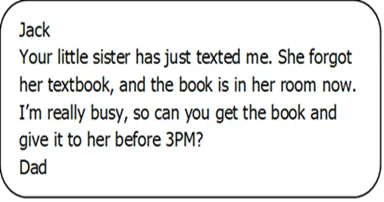
What does Jack’s dad want to say?
Đáp án: D
Read the following passage and mark the letter A, B, C, or D to indicate the correct answer to each of the following questions from 26 to 31.
Do you tend to see the positive, even in difficult times? Or do you quickly expect the worst and focus on the negative? When looking at life, most people are either optimistic or pessimistic. Experts say this is often influenced by how we were raised.
“From my experience, optimism is both a personality trait and a product of our environment,” says psychotherapist Karol Ward. “From an early age, babies and children pick up the emotional vibes in their homes. If the atmosphere is relaxing and loving, children grow well even if they are naturally anxious. But if the home is stressful and full of problems, children are more likely to become pessimistic. It’s hard to be open and hopeful when the adults around you don’t show it.”
But if you recognize yourself as someone who often thinks negatively, your childhood isn’t the only reason. Studies show that optimism is about 25% genetic, and then there are other factors that affect our positivity, like financial situation. Still, there is plenty of room to become more optimistic as an adult. Positive moods are linked to more left-brain activity, while negative emotions activate the right side.
“Some people are optimistic by nature, but many learn it over time. Anyone can become more optimistic—it’s about finding purpose in work and life,” says Leah Weiss, a Stanford professor. “When we work with purpose or live with purpose, we feel more satisfied and will see the glass as ‘half full.’
What is the main idea of the passage?
Đáp án: A
The word ‘relaxing’ in paragraph 2 is CLOSEST in meaning to ______.
Đáp án: C
How does the writer explain the causes of optimism and pessimism?
Đáp án: B
Which of the following is NOT mentioned in the text?
Đáp án: C
What final point does the author make about optimism?
Đáp án: B
The word ‘satisfied’ in paragraph 3 is OPPOSITE in meaning to ______.
Đáp án: D
THE BENEFITS OF LEARNING ENGLISH
1. English is an international language, so you can access lots of resources English which are available in print and online. Learning English (32) ______ and stay updated with global developments.
2. Learning a new language is one of the best ways to boost your brainpower. Learning English (33) ______ because there are more connections happening in the brain.
3. When you learn a new language, you have the habit of considering your word choices so that you can convey messages in a clear way. (34) ______.
4. Learning English is useful for exploring the world through travelling since you can communicate with local people effectively. (35) ______.
(Adapted from SGK Right on! 9)
Đáp án: B
Đáp án: A
Đáp án: C
Đáp án: D
His writing appears frequently in French, Mexican, and Canadian _______________. (PUBLISH)
Lời giải của đề gốc để bạn tự đối chiếu; câu tự luận không tính điểm.
- Chỗ trống cần một danh từ, cụ thể là danh từ số nhiều vì câu nhắc đến nhiều loại.
- publication(s) /ˌpʌblɪˈkeɪʃn/ (n): ấn phẩm
Dịch: Các bài viết của anh ấy thường xuyên xuất hiện trên các ấn phẩm của Pháp, Mexico và Canada.
The tasks were not _______________ enough for me and I got bored. (CHALLENGE)
Lời giải của đề gốc để bạn tự đối chiếu; câu tự luận không tính điểm.
- Chỗ trống cần một tính từ đi sau động từ to-be và bổ nghĩa cho chủ ngữ ‘The tasks’.
- Cấu trúc chỉ mức độ: (not) + adj/adv + enough + (for sb) + to V
- challenging /ˈtʃælɪndʒɪŋ/ (adj): khó khăn, thử thách
Dịch: Các nhiệm vụ không đủ khó đối với tôi và tôi thấy chán.
Modern science is critically _______________ on high-performance computing. (DEPEND)
Lời giải của đề gốc để bạn tự đối chiếu; câu tự luận không tính điểm.
- Chỗ trống cần một tính từ đi với giới từ ‘on’ bổ nghĩa cho chủ ngữ ‘Modern science’.
- dependent /dɪˈpendənt/ (adj): phụ thuộc vào cái gì
Dịch: Khoa học hiện đại phụ thuộc rất nhiều vào máy tính hiệu suất cao.
The process of _______________ to a new school is difficult for some children. (ADAPT)
Lời giải của đề gốc để bạn tự đối chiếu; câu tự luận không tính điểm.
- Chỗ trống cần một danh từ hoặc danh động từ (V-ing) sau giới từ ‘of’.
- adaptation /ˌædæpˈteɪʃn/ (n): sự thích nghi với môi trường mới
Dịch: Quá trình thích nghi với trường học mới là khó khăn đối với một vài trẻ.
We plan to _______________ the scope of our existing activities by offering more language courses. (WIDE)
Lời giải của đề gốc để bạn tự đối chiếu; câu tự luận không tính điểm.
- Chỗ trống cần một động từ nguyên mẫu; cấu trúc plan + to V: dự định làm gì
- widen /ˈwaɪdn/ (v): mở rộng về kích thước, quy mô
Dịch: Chúng tôi có kế hoạch mở rộng quy mô của các hoạt động hiện tại bằng cách cung cấp nhiều khóa học ngôn ngữ hơn.