Câu 1
I. Choose the word / phrase / sentence (A, B, C or D) that best fits the space or best answers the question given in each sentence.
Which word has the underlined part pronounced differently from that of the others?
Đáp án và lời giải
Đáp án: C
I. Choose the word / phrase / sentence (A, B, C or D) that best fits the space or best answers the question given in each sentence.
Which word has the underlined part pronounced differently from that of the others?
Đáp án: C
I. Choose the word / phrase / sentence (A, B, C or D) that best fits the space or best answers the question given in each sentence.
Which word has the underlined part pronounced differently from that of the others?
Đáp án: A
I. Choose the word / phrase / sentence (A, B, C or D) that best fits the space or best answers the question given in each sentence.
Which word has a different stress pattern from that of the others?
Đáp án: D
I. Choose the word / phrase / sentence (A, B, C or D) that best fits the space or best answers the question given in each sentence.
Which word has a different stress pattern from that of the others?
Đáp án: B
I. Choose the word / phrase / sentence (A, B, C or D) that best fits the space or best answers the question given in each sentence.
Trang: I'm terribly sorry. I ________ submit my assignment after the deadline. My laptop hasn't worked properly.
Ms Susan: Oh, that's okay, Trang. Please try to submit it tomorrow.
Đáp án: C
I. Choose the word / phrase / sentence (A, B, C or D) that best fits the space or best answers the question given in each sentence.
John: I heard you have a big interview coming ________. Best of luck!
Peter: Thank you! I appreciate it.
Đáp án: A
I. Choose the word / phrase / sentence (A, B, C or D) that best fits the space or best answers the question given in each sentence.
Linda: How would you feel about _______ out at the recycling event this weekend?
Sophia: I'd be happy to help! When does it start?
Đáp án: A
I. Choose the word / phrase / sentence (A, B, C or D) that best fits the space or best answers the question given in each sentence.
Tom is helping Jane to prepare for her presentation.
Tom: Okay, so to start the presentation, you'll need to ______ your topic and state your thesis. After that, you'll move on to your main points, supporting them with evidence. Got it?
Jane: OK. I got what you mean.
Đáp án: B
I. Choose the word / phrase / sentence (A, B, C or D) that best fits the space or best answers the question given in each sentence.
Colleague: I really hope you _______ in your new role at the company.
You: Thanks! I hope it's a good opportunity for growth.
Đáp án: C
I. Choose the word / phrase / sentence (A, B, C or D) that best fits the space or best answers the question given in each sentence.
Linh: I'm having trouble figuring out how to stay healthy. Do you have any advice for me?
Mia: Sure, focus on a _________ diet and regular exercise.
Đáp án: D
I. Choose the word / phrase / sentence (A, B, C or D) that best fits the space or best answers the question given in each sentence.
Binh: I can help you to look around to find out about ______ history of Bat Trang village.
Tom: Thanks. That's so kind of you.
Đáp án: C
I. Choose the word / phrase / sentence (A, B, C or D) that best fits the space or best answers the question given in each sentence.
Duong: I'm sorry, Teacher. I have _______ my textbook at home.
Teacher: That's alright.You can ask your friend to share.
Đáp án: B
I. Choose the word / phrase / sentence (A, B, C or D) that best fits the space or best answers the question given in each sentence.
Vy: What are the chances of a really big meteor hitting the Earth?
Brian:_______
Đáp án: C
I. Choose the word / phrase / sentence (A, B, C or D) that best fits the space or best answers the question given in each sentence.
Mary is talking to David, who has just helped her with her luggage.
Mary: _________
David: It’s my pleasure.
Đáp án: D
II. Look at each sign or notice. Choose the best answer (A, B, C or D) that matches its meaning.
What does the sign say?
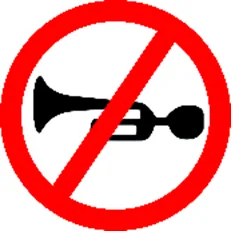
Đáp án: D
II. Look at each sign or notice. Choose the best answer (A, B, C or D) that matches its meaning.
What does Mom want Eric to do?
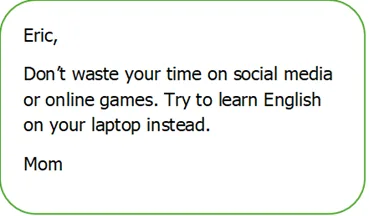
Đáp án: C
III. Choose the word (A, B, C or D) that best fits each blank space in the following passage.
Earth's Moon is the brightest and largest object (17) _________ our night sky. The Moon makes Earth a more (18) _________ planet by moderating our home planet's wobble on its axis, leading to a relatively stable climate. It also causes tides, (19) _________ a rhythm that has guided humans for thousands of years. The Moon was likely formed after a Mars-sized body collided with Earth several billion years ago. Earth's only natural satellite is simply called "the Moon" because people didn't know other moons existed until Galileo Galilei (20) _________ four moons orbiting Jupiter in 1610. In Latin, the Moon was called Luna, which is the main adjective for all things Moon-related: lunar. (21) _________ Earth, the Moon has a day side and a night side, which change as the Moon rotates. The Sun always (22) _________ half of the Moon while the other half remains dark.
Đáp án: B
III. Choose the word (A, B, C or D) that best fits each blank space in the following passage.
Earth's Moon is the brightest and largest object (17) _________ our night sky. The Moon makes Earth a more (18) _________ planet by moderating our home planet's wobble on its axis, leading to a relatively stable climate. It also causes tides, (19) _________ a rhythm that has guided humans for thousands of years. The Moon was likely formed after a Mars-sized body collided with Earth several billion years ago. Earth's only natural satellite is simply called "the Moon" because people didn't know other moons existed until Galileo Galilei (20) _________ four moons orbiting Jupiter in 1610. In Latin, the Moon was called Luna, which is the main adjective for all things Moon-related: lunar. (21) _________ Earth, the Moon has a day side and a night side, which change as the Moon rotates. The Sun always (22) _________ half of the Moon while the other half remains dark.
Đáp án: A
III. Choose the word (A, B, C or D) that best fits each blank space in the following passage.
Earth's Moon is the brightest and largest object (17) _________ our night sky. The Moon makes Earth a more (18) _________ planet by moderating our home planet's wobble on its axis, leading to a relatively stable climate. It also causes tides, (19) _________ a rhythm that has guided humans for thousands of years. The Moon was likely formed after a Mars-sized body collided with Earth several billion years ago. Earth's only natural satellite is simply called "the Moon" because people didn't know other moons existed until Galileo Galilei (20) _________ four moons orbiting Jupiter in 1610. In Latin, the Moon was called Luna, which is the main adjective for all things Moon-related: lunar. (21) _________ Earth, the Moon has a day side and a night side, which change as the Moon rotates. The Sun always (22) _________ half of the Moon while the other half remains dark.
Đáp án: D
III. Choose the word (A, B, C or D) that best fits each blank space in the following passage.
Earth's Moon is the brightest and largest object (17) _________ our night sky. The Moon makes Earth a more (18) _________ planet by moderating our home planet's wobble on its axis, leading to a relatively stable climate. It also causes tides, (19) _________ a rhythm that has guided humans for thousands of years. The Moon was likely formed after a Mars-sized body collided with Earth several billion years ago. Earth's only natural satellite is simply called "the Moon" because people didn't know other moons existed until Galileo Galilei (20) _________ four moons orbiting Jupiter in 1610. In Latin, the Moon was called Luna, which is the main adjective for all things Moon-related: lunar. (21) _________ Earth, the Moon has a day side and a night side, which change as the Moon rotates. The Sun always (22) _________ half of the Moon while the other half remains dark.
Đáp án: B
IV. Read the following and do as directed.
Born in Marton, near Middlesborough, Captain James Cook would go on to become one of the most famous explorers in British maritime history.
Indeed, young James’ childhood was nothing remarkable, and following his rudimentary education, Cook became an apprentice to William Sanderson, a local grocer. After 18 months working next to Staithes’ busy harbor, James felt the calling of the sea. Not wanting to stand in the young man’s way, he introduced Cook to his friend, John Walker, a ship owner from Whitby, who took him on as an apprentice seaman.
Cook lived in the Walker family house in Whitby and went to school with the other apprentices in the town. Cook worked hard and was soon serving on one of Walkers’ “cats”, the Freelove. Cats were hardy ships, built in Whitby to take coal down the coast to London. Cook was a quick learner and rapidly established himself as one of the most promising apprentices in Walker’s care.
In 1750, Cook’s apprenticeship with the Walkers ended, though he carried on working for them as a seaman. As always with Cook, it wasn’t long before he was promoted, and in 1755, he was offered the command of the Friendship, a cat he was familiar with. For many, this would have been the realization of an ambition, and they would have grasped the chance with both hands. Cook, however, wanted more than to spend his remaining years sailing in coastal waters in poor weather, so he politely turned down the Walkers’ offer and joined the Royal Navy.
Decide whether the following sentences are True or False.
James Cook was one of the most well-known British men to explore land masses in history.
Đáp án: B
IV. Read the following and do as directed.
Born in Marton, near Middlesborough, Captain James Cook would go on to become one of the most famous explorers in British maritime history.
Indeed, young James’ childhood was nothing remarkable, and following his rudimentary education, Cook became an apprentice to William Sanderson, a local grocer. After 18 months working next to Staithes’ busy harbor, James felt the calling of the sea. Not wanting to stand in the young man’s way, he introduced Cook to his friend, John Walker, a ship owner from Whitby, who took him on as an apprentice seaman.
Cook lived in the Walker family house in Whitby and went to school with the other apprentices in the town. Cook worked hard and was soon serving on one of Walkers’ “cats”, the Freelove. Cats were hardy ships, built in Whitby to take coal down the coast to London. Cook was a quick learner and rapidly established himself as one of the most promising apprentices in Walker’s care.
In 1750, Cook’s apprenticeship with the Walkers ended, though he carried on working for them as a seaman. As always with Cook, it wasn’t long before he was promoted, and in 1755, he was offered the command of the Friendship, a cat he was familiar with. For many, this would have been the realization of an ambition, and they would have grasped the chance with both hands. Cook, however, wanted more than to spend his remaining years sailing in coastal waters in poor weather, so he politely turned down the Walkers’ offer and joined the Royal Navy.
Decide whether the following sentences are True or False.
His life as a child was normal, which was followed by his advanced education.
Đáp án: B
IV. Read the following and do as directed.
Born in Marton, near Middlesborough, Captain James Cook would go on to become one of the most famous explorers in British maritime history.
Indeed, young James’ childhood was nothing remarkable, and following his rudimentary education, Cook became an apprentice to William Sanderson, a local grocer. After 18 months working next to Staithes’ busy harbor, James felt the calling of the sea. Not wanting to stand in the young man’s way, he introduced Cook to his friend, John Walker, a ship owner from Whitby, who took him on as an apprentice seaman.
Cook lived in the Walker family house in Whitby and went to school with the other apprentices in the town. Cook worked hard and was soon serving on one of Walkers’ “cats”, the Freelove. Cats were hardy ships, built in Whitby to take coal down the coast to London. Cook was a quick learner and rapidly established himself as one of the most promising apprentices in Walker’s care.
In 1750, Cook’s apprenticeship with the Walkers ended, though he carried on working for them as a seaman. As always with Cook, it wasn’t long before he was promoted, and in 1755, he was offered the command of the Friendship, a cat he was familiar with. For many, this would have been the realization of an ambition, and they would have grasped the chance with both hands. Cook, however, wanted more than to spend his remaining years sailing in coastal waters in poor weather, so he politely turned down the Walkers’ offer and joined the Royal Navy.
Decide whether the following sentences are True or False.
James Cook spent a year and a half working with Staithes in a busy harbor.
Đáp án: A
IV. Read the following and do as directed.
Born in Marton, near Middlesborough, Captain James Cook would go on to become one of the most famous explorers in British maritime history.
Indeed, young James’ childhood was nothing remarkable, and following his rudimentary education, Cook became an apprentice to William Sanderson, a local grocer. After 18 months working next to Staithes’ busy harbor, James felt the calling of the sea. Not wanting to stand in the young man’s way, he introduced Cook to his friend, John Walker, a ship owner from Whitby, who took him on as an apprentice seaman.
Cook lived in the Walker family house in Whitby and went to school with the other apprentices in the town. Cook worked hard and was soon serving on one of Walkers’ “cats”, the Freelove. Cats were hardy ships, built in Whitby to take coal down the coast to London. Cook was a quick learner and rapidly established himself as one of the most promising apprentices in Walker’s care.
In 1750, Cook’s apprenticeship with the Walkers ended, though he carried on working for them as a seaman. As always with Cook, it wasn’t long before he was promoted, and in 1755, he was offered the command of the Friendship, a cat he was familiar with. For many, this would have been the realization of an ambition, and they would have grasped the chance with both hands. Cook, however, wanted more than to spend his remaining years sailing in coastal waters in poor weather, so he politely turned down the Walkers’ offer and joined the Royal Navy.
Decide whether the following sentences are True or False.
The Walkers stopped training James Cook in the mid-18th century.
Đáp án: A
Choose the correct answer to each question.
What can be served as the best title for the passage?
Đáp án: B
Choose the correct answer to each question.
Which one is true about James Cook?
Đáp án: C